Subscribe by Email

Your email:

Posts by category

Costa Rica Blog

Current Articles | RSS Feed RSS Feed

International Living Event in Costa Rica and 4 back to back tours

  | Share on Twitter Twitter | Share on Facebook Facebook | Submit to Digg digg it |  Add to delicious  delicious |  Submit to StumbleUpon StumbleUpon |  Share on LinkedIn LinkedIn |  Share On Technorati Technorati | Submit to Reddit reddit 

Get a free DVD about Costa Rica here FREE DVD 


Many of you may realize that last week International Living held an event at the San Jose Marriott "Live and Invest in Costa Rica".  As the sponsor for the event, we provided the entire conference with an opening cocktail reception with open bar and appetizers.  I also gave a presentation during the event about our project in Costa Rica and we had a booth in the exhibit room.  The Marriott is a beautiful hotel and the conference center is equally as nice.  The event was attended by over 200 people.

hotel marriott costa rica picture 1These shows take a lot out of you.  You have to arrive in the exhibit room before 8:00 am and are typically there until well after 7:00 pm.  Fortunately Patrick came and worked the event with me. 

To further compound the challenge of the event, Kristina and I had booked four Discovery property tours to coincide with the event.  The first scheduled for August 6-9 was booked with 21 people.  For those of you who have been to the guest house, you realize we can't fit 21 people at the guest house.  We booked the entire Buena Vista Hotel for the overflow, as well as the guest house.  We had to use a 28 passenger Coaster Bus to move the group from San Jose and back.  Even with the new Caldera and Costanera highway, this big bus would be much slower than our normal tourist vans.  I also had to transport those clients at the Buena Vista to and from the guest house each day since all our meals would be served at the guest house.  I have already received a great deal of praise from those on the tours, how great the time was, how wonderful the project is and how good that food was.  The weather cooperated well except that on the third tour, we did have some early rain on the day we were visiting the properties.  It is hard to appreciate a great ocean view when all you could see was clouds reflecting off the ocean.

The event at the Marriott ran August 11-13.  On the morning of the 14th we headed south again with another 21 people for the tour.  On the 16th, another group came down in the same bus that would take the group back to San Jose that was already there.  On the 18th another group came down as the third group was leaving.  All in all the tours went smoothly, Mayca (our chef) did a great job preparing meals for 25 people each day on the bigger tours.  She prepared and plated 75 meals a day including her famous home made bread and french pastry desserts. 

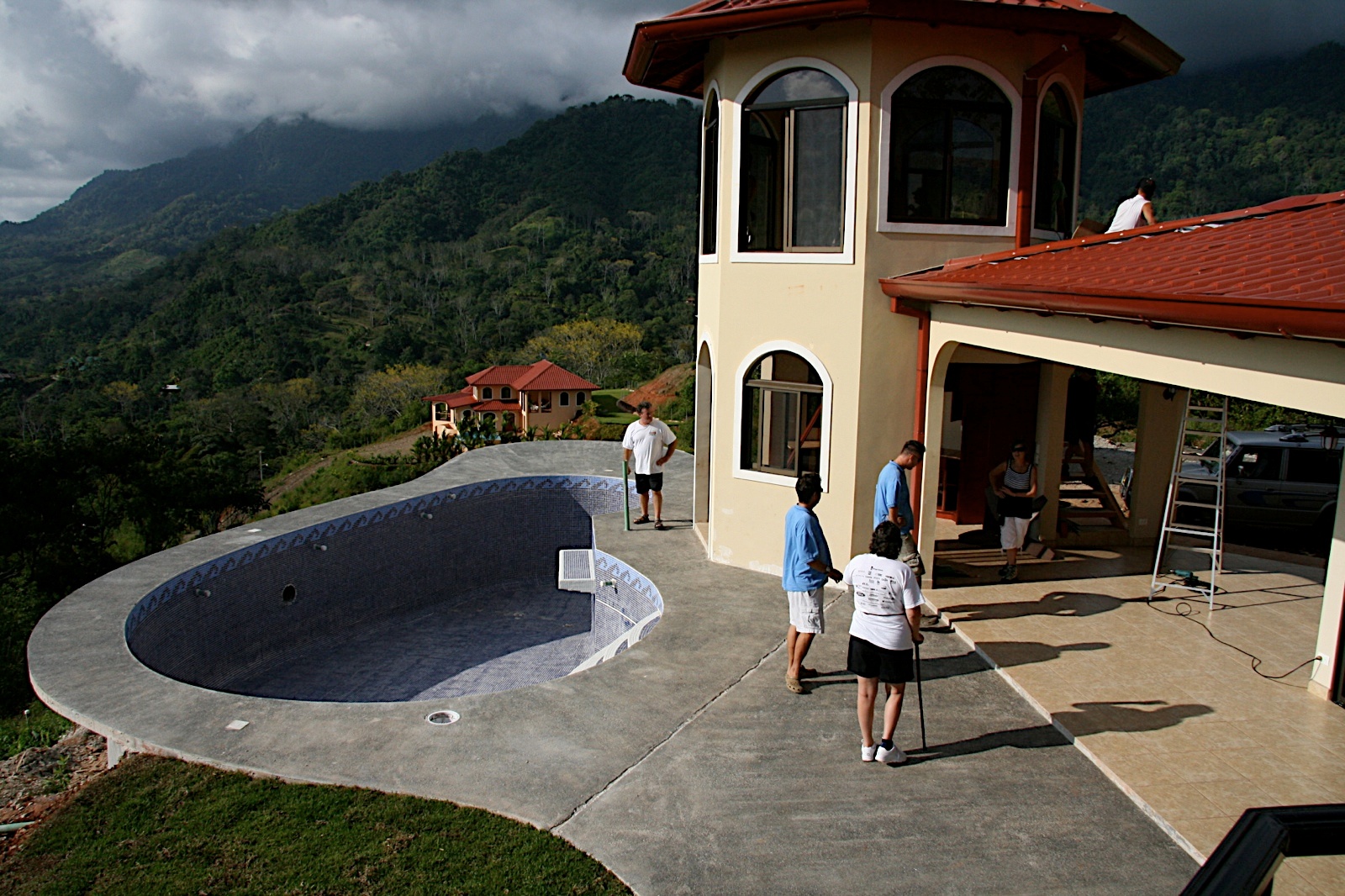
The highlight of these trips for me was that I sold the model home we have been using as a bathroom stop in phase 5.  Many of you have visited this home, great ocean view, waterfall into the pool and fantastic landscape.  We sold well over a million dollars in home sites over the 14 days and have a few more sales in negotiation.  All in all I am glad it is over.  Now only three more weeks until Kristina and I head to Las Vegas for the "Live and Invest Overseas" show that already had nearly 400 people signed up to attend.  I am grateful that our project is so popular and things are only getting better each time I am there.  Pacific Lots of Costa Rica was the most popular project at the event this time and continues to be the most successful single family real estate project in Costa Rica

Please tell your friends about our blog and feel free to 

SUBSCRIBE OR LINK TO OUR BLOG as well. 


Why can't we get a one day tour of your Costa Rica Property?

  | Share on Twitter Twitter | Share on Facebook Facebook | Submit to Digg digg it |  Add to delicious  delicious |  Submit to StumbleUpon StumbleUpon |  Share on LinkedIn LinkedIn |  Share On Technorati Technorati | Submit to Reddit reddit 

Get a free DVD about Costa Rica here FREE DVD 


Here is an email I recently wrote to one of our clients that wanted a tour of a few hours with little notice.

I have been communicating with both of you for quite some time now, and recently about visiting in late July.  As I might have explained in the past, we are not a 40 acre development like most others and our property can not be seen and what we have to sell can not be appreciated in a few hour visit.  Our staff is busy, we operate a guest house for the sole purpose of providing tours of our property and keep a full staff dedicated just to show our properties and prepare our meals.  Our staff is busy, we are not realtors, we are developers, our staff runs our tours and after 21 years of experience, we know that a tour of two hours will do nothing except leave you wanting to see more, spend more time, visit some of the custom homes we are building, tour our workshops where we make all our own doors, windows, counters, custom cabinetry, wrought iron work, etc. that is you’ll just end up wanting to take a full tour before you can make any kind of decision. 

Keep in mind that we are the largest residential project in the country.  Our latest development encompasses over 2200 acres and our first 9 phases are sold out, with over a 1000 customers to date.  Our method of showing our property is not because we want to waste your time for 2 days, it is because it takes time to see what we offer to our clients, the largest development in the country, custom home building services, full property management services, rental management, a turn key system of home ownership where every home is custom built and our community is why we are the most successful project in the country.  Safety, the ease of getting a home built, true residential zoning (not agricultural or parcela minima), roads, artesian well water plumbed to each lot and electric provided in all developments, help with residency, assistance opening bank accounts, facilitating purchase through self directed retirement programs, etc.  Our tours are almost always sold out, just check our website to see.  We continue to sell millions of dollars in properties each month while most other developers are struggling to stay in business.  We have no bank loans, are debt free and have over 500 full time employees.

touring our developmentsWe do have a two day tour running July 26th and 27th, starting at noon on the 26th and ending after breakfast on the 28th.  We will be looking at custom homes we are building on the afternoon (after lunch) on the 26th and we’ll be looking at available home sites on the morning of the 27th (after breakfast).  We’ll tour the hospital, our wood shop, swim at a local Pacific beach, visit a local supermarket on the afternoon of the 27th although some on the tour will also want to re-visit home sites for their final selection.  However for you to show up on the 27th and see available home sites while not having already seen how we build homes, how to build on the side of a mountain, our construction methods (not concrete block like everyone else but in fact a high tech product introduced into Costa Rica by the Four Seasons Hotel chain) understand what services we offer and our community, will leave you comparing our dirt to dirt you’d seen being offered by every other project in Costa Rica.  Our dirt costs a bit more comparatively, on a per acre basis, since our infrastructure is much better, we develop in true urbanization zoning, we meet all municipal standards, we guarantee title, we offer full financing of land, etc.  The quality of our roads, the purity of our water system, the engineering, permitting, etc are why we continue to grow while many other projects have gone bankrupt.

Our staff will be busy on the days you are there running the tour running July 26 – 28.  The folks on that tour have paid a $250 deposit per person to attend the tour and they deserve our attention.  We credit the deposit to the purchase price of any property and we give them a $1000 travel credit as well, toward any purchase in our developments.  We feed them, house them, take them on tours for two days, show them the hospital, the woodshop, the community, etc.  That is how our program works.

If you want a one day tour (this would require at least 5 hours) I can arrange such a tour by paying an owner in our community (not an employee of our company) but just a home owner who lives in our phase 9 to tour people through our project.  I have to pay that person $20 per hour to do so, they use their car, their time and they take you to lunch mid day since you will be hungry before the tour is finished and lunch gives you a break to digest what you have been seeing.  Most of the time you will be asking questions, real questions being answered by owners in our community, not some sales guy.  In fact all of our staff live in town, including the owner of the development.  We do not have any of the realty firms represent us, they would not know where to begin. 

So that is the answer to your request for a tour, again I suggest you take the full tour, spend the time, get what you paid for.  If you want a one day tour, I can arrange that but you will have to pay $100 via a credit card to us since that is what it will cost us to provide that tour.  You will also have to pay for your own lunch, which will likely be at Café Exotica, one of the many local restaurants in our community.  We are not a tourist town, we are a residential community.  You don’t want to live in a tourist town, which relies on transient renters to keep business alive.  Transients don’t provide a community, the locals in tourist towns are all employed in businesses that take care of tourists.

There are many projects that just have not and will never complete what they have promised to others.  The reason why International Living continues to invite us to every show they put on, why we are a sponsor of many events, why we were the major sponsor in Quito, Toronto, San Jose, Las Vegas, Denver, Cancun, etc is because we are worth the time to visit and both the education you will get and the opportunity to purchase in a well planned, well managed development are worth every penny and every minute you will spend in the process.  Even those who don’t like our project (we are not for everyone) are still thankful for the education and knowledge they have received about purchasing property in Costa Rica or in any other foreign country.


Please tell your friends about our blog and feel free to 

SUBSCRIBE OR LINK TO OUR BLOG as well. 


Costa Rica tops Gallup poll for Global Wellbeing

  | Share on Twitter Twitter | Share on Facebook Facebook | Submit to Digg digg it |  Add to delicious  delicious |  Submit to StumbleUpon StumbleUpon |  Share on LinkedIn LinkedIn |  Share On Technorati Technorati | Submit to Reddit reddit 

Get a free DVD about Costa Rica here FREE DVD 


This article is from our latest newsletter which you can find on the front page of our website. 

sunset and drinks at Hotel MariposaGallup, the provider of reliable and respected opinion polls in over 155 countries recently concluded its 5 year study called "Gallup Global Wellbeing".  Gallup's global wellbeing metrics are the first comprehensive measure of the behavioral economics of gross national wellbeing, which lays the foundation for all other measures of a country's economic strength.  Gallup asks ordinary individuals for their thoughts and opinions on several topics, including economics, religion, migration, and wellbeing. They then classified respondents as "thriving", "struggling" or "suffering" upon how they rated their current and future lives.

According to the polls, Africa has the lowest wellbeing with no country in the region with a thriving percentage higher than 25%.  Thriving in the Americas is highest in Costa Rica at 63% and Canada at 62% followed by Panama 58%, Brazil 58% and the United States 57%. 

For more information click here: http://www.gallup.com/poll/126977/Global-WellBeing-Surveys-Find-Nations-Worlds-Apart.aspx

Please tell your friends about our blog and feel free to 

SUBSCRIBE OR LINK TO OUR BLOG as well. 


Costa Rica versus Panama, a Comparison for Expats

  | Share on Twitter Twitter | Share on Facebook Facebook | Submit to Digg digg it |  Add to delicious  delicious |  Submit to StumbleUpon StumbleUpon |  Share on LinkedIn LinkedIn |  Share On Technorati Technorati | Submit to Reddit reddit 

Get a free DVD about Costa Rica here FREE DVD 


People ask all the time about Panama as the new Costa Rica.  Both are popular expat locations and both have pros and cons.  Panama is cheaper from a tax perspective since under the pensionado program there, property taxes are waived for at least 10 years but keep in mind that many who move there do not do so under the pensionado program, therefore they still pay property taxes.  Candidly property taxes are low in both countries, so low that to base a consideration on where to live on that aspect makes no sense.  Choose the place you like the best based on quality of life, health care, ease and cost of accessibility, activities available, infrastructure, friendliness, etc.  Cost of living is candidly about the same in either country.  Living in Panama City is similar to living in San Jose, lots of expats, more crime, like city living anywhere. 

Costa Rica has many more Americans living there.  There are only a handful of American expat communities in Panama, Boquette, El Valle, Boca Del Toros, all far away from Panama City.  Panama is still trying hard to attract expats while Costa Rica is trying to slow down the inflow a bit.  Sure I'm biased to Costa Rica but here are some facts that might also help you understand why we chose Costa Rica over Panama.

Looking at statistics on things like availability of clean drinking water, number of students enrolled in secondary educational istitutes, number of population living in poverty, Costa Rica is just much better.  When basic needs are met, people prepare, educate and improve their situations.  When basic needs are not met, people fall behind. 

crime stats central AmericaAccording to the United nations Office of Drugs and Crime One of the main reasons to prefer Costa Rica over Panama is the size of the middle class in Costa Rica versus Panama.  According to the United nations Office of Drugs and Crime, in Panama nearly 81% of total population was living on less than $2.00 per day per capita in 2005.  The number was only 13% in Costa Rica.  There is also much higher use of drugs in Panama, both marijuana and cocaine.  In Costa Rica, most of the population is descended from European Spanish, nearly 96%, while in Panama most are descended from groups indigenous to Latin America and Africa.  The literacy rate in Costa Rica educational levels attained are much higher than in Panama.   

Flights to Panama versus Flights to Costa Rica

If you look on sites like Kayak, Expedia or Travelocity for flights to Panama city, Panama Tocumen International, Airport code PTY you will see that the main carrier to PTY is TACA airlines and Copa.  The airport is also serviced by American, Delta, United, Mexicana, Avianca, and Lacsa.  The average price from Miami is under $300 on TACA but once you get onto an American bases airline, the price jumps to over $400 on American, over $500 on Continental and over $900 on Delta.

Performing the same search from Miami to San Jose Costa Rica (Juan Santamaria airport, code SJO) you will find United at $250, American at $301, Continenal at $302, Delta at $411, US Air at $400 and even carriers like Alaska Airlines, Jet Blue, Spirit Airlines, Frontier Airlines, as well as TACA, Lacsa, Mexicana and Avianca.  More airlines and more flights equates to lower prices and more competition.  So if you end up going back to the states or Canada a few times each year, your cost of accessibility will be significantly lower. 

Pensionado Programs:  Costa Rica has one of the oldest pensionado (retiree) programs on the planet.  They reduced and eliminated many of the incentives they once offered to expats looking to immigrate there.  They did so since their pensionado program was hugely successful.  They initially offered a tax free import allowance though they do not any more.  Typically the duty on a 40 foot container of household goods is about $1500 (quoted from ABC Moving) so there is your guideline on potential savings verus Panama.

Panama has a newer pensionado program.  They are still trying to entice expats to move there.  They are still offering a tax free allowance on personal goods coming to Panama for expats.  In reality most expats bring little or nothing with them preferring to sell their possessions in the states and buy new ones that may be more appropriate to their new climate.  Panama currently also grants a haven from property tax for the first x number of years. (x is currently 20).  This exemption is subject to change but presently will save you about $200-$800 per year over a similiar home in Costa Rica.  So the savings you may get through the current Pensionado program in Panama would potentially be offset by a couple traveling to the states once or twice per year at higher airfares.  So let's compare some other considerations.

Crime: The 2009-2010 UNDP Human Development Report for Central America shows the homicide rate in Panama in 2008 was 19 per 100,000 inhabitants; much higher than the 2007 statistics, estimated at 13 per 100,000 inhabitants, and the 2000 figures that showed 10 per 100,000 inhabitants.

"Unfortunately, Panama had an impressive jump," said Hernando Gómez Buendia, coordinator of the report.

The report revealed that Panama is below Honduras, El Salvador, Guatemala, and Belize, which showed rates of 58, 52, 48 and 32 homicides per 100,000 inhabitants, respectively. Nonetheless, Panama is the country that observed the greatest increase in crime statistics across the region, according to the report.

Costa Rica showed a homicide rate of 11 per 100,000, up from 9 in 2007.  The figure is 10 per 100,000 in the US.   


Geography of Panama

Location: Middle America, bordering both the Caribbean Sea and the North Pacific Ocean, between Colombia and Costa Rica
Coordinates: 9 00 N, 80 00 W
Area: total: 78,200 sq km
water: 2,210 sq km
land: 75,990 sq km
Area comparative: slightly smaller than South Carolina
Land boundaries: total: 555 km
border countries: Colombia 225 km, Costa Rica 330 km
Coastline: 2,490 km
Maritime claims: contiguous zone: 24 NM
exclusive economic zone: 200 NM
territorial sea: 12 NM
Climate: tropical maritime; hot, humid, cloudy; prolonged rainy season (May to January), short dry season (January to May)
Terrain: interior mostly steep, rugged mountains and dissected, upland plains; coastal areas largely plains and rolling hills
Elevation extremes: lowest point: Pacific Ocean 0 m
highest point: Volcan de Chiriqui 3,475 m
Natural resources: copper, mahogany forests, shrimp, hydropower
Natural hazards: occasional severe storms and forest fires in the Darien area
Environment current issues: water pollution from agricultural runoff threatens fishery resources; deforestation of tropical rain forest; land degradation and soil erosion threatens siltation of Panama Canal; air pollution in urban areas; mining threatens natural resources
Geography - note: strategic location on eastern end of isthmus forming land bridge connecting North and South America; controls Panama Canal that links North Atlantic Ocean via Caribbean Sea with North Pacific Ocean

Population of Panama

Population: 3,309,679 (July 2008 est.)
Age structure: 0-14 years: 30.3% (male 492,403/female 472,996)
15-64 years: 63.4% (male 1,025,898/female 998,926)
65 years and over: 6.3% (male 94,122/female 106,974)
Median age: 26.1 years
Growth rate: 1.6%
Infant mortality: 16.37 deaths/1,000 live births
Life expectancy at birth: total population: 75.22 years
male: 72.68 years
female: 77.87 years
Fertility rate: 2.68 children born/woman
Nationality: noun: Panamanian(s)
adjective: Panamanian
Ethnic groups: mestizo (mixed Amerindian and white) 70%, Amerindian and mixed (West Indian) 14%, white 10%, Amerindian 6%
Religions: Roman Catholic 85%, Protestant 15%
Languages: Spanish (official), English 14%
note: many Panamanians bilingual
Literacy: definition: age 15 and over can read and write
total population: 92.6%
male: 93.2%
female: 91.9% 

Government

Country name: conventional long form: Republic of Panama
local long form: Republica de Panama
Government type: constitutional democracy
Capital: Panama
Administrative divisions: 9 provinces (provincias, singular - provincia) and 1 territory* (comarca); Bocas del Toro, Chiriqui, Cocle, Colon, Darien, Herrera, Los Santos, Panama, San Blas*, and Veraguas
Independence: 3 November 1903 (from Colombia; became independent from Spain 28 November 1821)
National holiday: Independence Day, 3 November (1903)
Constitution: 11 October 1972; major reforms adopted 1978, 1983 and 1994
Legal system: based on civil law system; judicial review of legislative acts in the Supreme Court of Justice; accepts compulsory ICJ jurisdiction, with reservations
Suffrage: 18 years of age; universal and compulsory
Executive branch: chief of state: President Martin TORRIJOS Espino (since 1 September 2004); First Vice President Samuel LEWIS Navarro (since 1 September 2004); Second Vice President Ruben AROSEMENA Valdes (since 1 September 2004); note - the president is both the chief of state and head of government
head of government: President Martin TORRIJOS Espino (since 1 September 2004); First Vice President Samuel LEWIS Navarro (since 1 September 2004); Second Vice President Ruben AROSEMENA Valdes (since 1 September 2004)
cabinet: Cabinet appointed by the president
elections: president and vice presidents elected on the same ticket by popular vote for five-year terms (not eligible for immediate reelection; president and vice presidents must sit out two additional terms (10 years) before becoming eligible for reelection); election last held 2 May 2004 (next to be held on 3 May 2009); note - beginning in 2009, Panama will have only one vice president.
Legislative branch: unicameral National Assembly (formerly called Legislative Assembly) or Asamblea Nacional (78 seats; members are elected by popular vote to serve five-year terms); note - in 2009, the number of seats will change to 71
Judicial branch: Supreme Court of Justice or Corte Suprema de Justicia (nine judges appointed for 10-year terms); five superior courts; three courts of appeal

Economy

Panama's dollarized economy rests primarily on a well-developed services sector that accounts for two-thirds of GDP. Services include operating the Panama Canal, banking, the Colon Free Zone, insurance, container ports, flagship registry, and tourism. Economic growth will be bolstered by the Panama Canal expansion project that began in 2007 and should be completed by 2014 at a cost of $5.3 billion (about 30% of current GDP). The expansion project will more than double the Canal's capacity, enabling it to accommodate ships that are now too large to transverse the transoceanic crossway and should help to reduce the high unemployment rate. The government has implemented tax reforms, as well as social security reforms, and backs regional trade agreements and development of tourism. Not a CAFTA signatory, Panama in December 2006 independently negotiated a free trade agreement with the US, which, when implemented, will help promote the country's economic growth.

GDP: $34.81 billion (2007 est.)
GDP growth rate: 6.4%
GDP per capita: $10,700
GDP composition by sector: agriculture: 6.8%
industry: 15.6%
services: 77.6%
Inflation rate: 2.9%
Labor force: 1.39 million
note: shortage of skilled labor, but an oversupply of unskilled labor
Labor force - by occupation: agriculture: 20.8%
industry: 18%
services: 61.2%
Unemployment: 9.8%
Electricity production by source: fossil fuel: 37%
hydro: 61.3%
other: 1.7%
nuclear: 0%
Industries: construction, brewing, cement and other construction materials, sugar milling
Agriculture: bananas, rice, corn, coffee, sugarcane, vegetables; livestock; shrimp
Exports: bananas, shrimp, sugar, coffee, clothing
Export partners: US 18.3%, Spain 15.6%, Germany 7.9%, Greece 4.1%
Imports: capital goods, foodstuffs, consumer goods, chemicals
Import partners: Japan 36.2%, China 16.5%, US 11.4%, Singapore 10%
Currency: balboa (PAB); US dollar (USD)
Currency code: PAB; USD

SOURCES: The CIA World Factbook, U.S. Department of State, Area Handbook of the US Library of Congress

Geography of Costa Rica

Location: Middle America, bordering both the Caribbean Sea and the North Pacific Ocean, between Nicaragua and Panama
Coordinates: 10 00 N, 84 00 W
Area: total: 51,100 sq km
water: 440 sq km
note: includes Isla del Coco
land: 50,660 sq km
Area comparative: slightly smaller than West Virginia
Land boundaries: total: 639 km
border countries: Nicaragua 309 km, Panama 330 km
Coastline: 1,290 km
Maritime claims: continental shelf: 200 NM
exclusive economic zone: 200 NM
territorial sea: 12 NM
Climate: tropical and subtropical; dry season (December to April); rainy season (May to November); cooler in highlands
Terrain: coastal plains separated by rugged mountains including over 100 volcanic cones, of which several are major volcanoes
Elevation extremes: lowest point: Pacific Ocean 0 m
highest point: Cerro Chirripo 3,810 m
Natural resources: hydropower
Natural hazards: occasional earthquakes, hurricanes along Atlantic coast; frequent flooding of lowlands at onset of rainy season and landslides; active volcanoes
Environment - current issues: deforestation and land use change, largely a result of the clearing of land for cattle ranching and agriculture; soil erosion; coastal marine pollution; fisheries protection; solid waste management; air pollution
Geography - note: four volcanoes, two of them active, rise near the capital of San Jose in the center of the country; one of the volcanoes, Irazu, erupted destructively in 1963-65

Population of Costa Rica

Population: 4,195,914 (July 2008 est.)
Age structure: 0-14 years: 28.3% (male 590,261/female 563,196)
15-64 years: 66% (male 1,359,750/female 1,329,346)
65 years and over: 5.7% (male 108,041/female 124,667)
Median age: 26.4 years
Growth rate: 1.45%
Infant mortality: 9.7 deaths/1,000 live births
Life expectancy at birth: total population: 77.02 years
male: 74.43 years
female: 79.74 years
Total fertility rate: 2.24 children born/woman
Nationality: noun: Costa Rican(s)
adjective: Costa Rican
Ethnic groups: white (including mestizo) 94%, black 3%, Amerindian 1%, Chinese 1%, other 1%
Religions: Roman Catholic 76.3%, Evangelical 13.7%, Jehovah's Witnesses 1.3%, other Protestant 0.7%, other 4.8%, none 3.2%
Languages: Spanish (official), English
Literacy: definition: age 15 and over can read and write
total population: 96%
male: 95.9%
female: 96.1%

Government

Country name: conventional long form: Republic of Costa Rica
local long form: Republica de Costa Rica
Government type: democratic republic
Capital: San Jose
Administrative divisions: 7 provinces (provincias, singular - provincia); Alajuela, Cartago, Guanacaste, Heredia, Limon, Puntarenas, San Jose
Independence: 15 September 1821 (from Spain)
National holiday: Independence Day, 15 September (1821)
Constitution: 7 November 1949
Legal system: based on Spanish civil law system; judicial review of legislative acts in the Supreme Court; has accepted compulsory ICJ jurisdiction
Suffrage: 18 years of age; universal and compulsory
Executive branch: chief of state: President Oscar ARIAS Sanchez (since 8 May 2006); First Vice President Laura CHINCHILLA (since 8 May 2006); Second Vice President (vacant); note - the president is both the chief of state and head of government
head of government: President Oscar ARIAS Sanchez (since 8 May 2006); First Vice President Laura CHINCHILLA (since 8 May 2006); Second Vice President (vacant)
cabinet: Cabinet selected by the president
elections: president and vice presidents elected on the same ticket by popular vote for a single four-year term; election last held 5 February 2006 (next to be held in February 2010)
Legislative branch: unicameral Legislative Assembly or Asamblea Legislativa (57 seats; members are elected by direct, popular vote to serve four-year terms)
Judicial branch: Supreme Court or Corte Suprema (22 justices are elected for eight-year terms by the Legislative Assembly)

Economy

Costa Rica's basically stable economy depends on tourism, agriculture, and electronics exports. Poverty has remained around 20% for nearly 20 years, and the strong social safety net that had been put into place by the government has eroded due to increased financial constraints on government expenditures. Immigration from Nicaragua has increasingly become a concern for the government. The estimated 300,000-500,000 Nicaraguans estimated to be in Costa Rica legally and illegally are an important source of (mostly unskilled) labor, but also place heavy demands on the social welfare system. Foreign investors remain attracted by the country's political stability and high education levels, as well as the fiscal incentives offered in the free-trade zones. Exports have become more diversified in the past 10 years due to the growth of the high-tech manufacturing sector, which is dominated by the microprocessor industry. Tourism continues to bring in foreign exchange, as Costa Rica's impressive biodiversity makes it a key destination for ecotourism. The government continues to grapple with its large internal and external deficits and sizable internal debt. Reducing inflation remains a difficult problem because of rising import prices, labor market rigidities, and fiscal deficits. Tax and public expenditure reforms will be necessary to close the budget gap. In October 2007, a national referendum voted in favor of the US-Central American Free Trade Agreement (CAFTA).

GDP: $45.77 billion (2007 est.)
GDP growth rate: 4%
GDP per capita: $11,100
GDP composition by sector: agriculture: 8.8%
industry: 29.9%
services: 61.4%
Inflation rate: 13.8%
Labor force: 1.82 million
Labor force - by occupation: agriculture: 20%
industry: 22%
services: 58%
Unemployment: 6.6%
Budget: revenues: $2.722 billion
expenditures: $3.195 billion
Electricity production by source: fossil fuel: 1.5%
hydro: 81.9%
other: 16.6% 
nuclear: 0%
Industries: microprocessors, food processing, textiles and clothing, construction materials, fertilizer, plastic products
Agriculture: coffee, pineapples, bananas, sugar, corn, rice, beans, potatoes; beef; timber
Exports: coffee, bananas, sugar; pineapples; textiles, electronic components, medical equipment
Export partners: US 30.3%, Netherlands 13.1%, UK 7.9%, China 7.7%
Imports: raw materials, consumer goods, capital equipment, petroleum
Import partners: US 43.2%, Japan 5.8%, Mexico 5.5%, Brazil 4.6%, Venezuela 4.5%
Currency: Costa Rican colon (CRC)

SOURCES: The CIA World Factbook, U.S. Department of State, Area Handbook of the US Library of Congress

Unicef's basic indicators on health, nutrition, education, economic condition, demographics and life expectancy puts Costa Rica WAY ON TOP.  Here are links to both countries for you to compare

http://www.unicef.org/infobycountry/costarica_statistics.html

http://www.unicef.org/infobycountry/panama_statistics.html


Please tell your friends about our blog and feel free to 

SUBSCRIBE OR LINK TO OUR BLOG as well. 


Banking in Costa Rica - An hour at a time

  | Share on Twitter Twitter | Share on Facebook Facebook | Submit to Digg digg it |  Add to delicious  delicious |  Submit to StumbleUpon StumbleUpon |  Share on LinkedIn LinkedIn |  Share On Technorati Technorati | Submit to Reddit reddit 

Get a free DVD about Costa Rica here FREE DVD 


Banking - I found myself at odds with the bank this past visit.  I'd tried to visit on the 31st of December (seems my Banco National card was due to expire at midnight) only to find the bank closed early for "la fiesta".  I dared to push my card into the Cajero (ATM) only to find out that it had already decided to celebrate New Year's, at 3:00 pm when the bank closed.  At least it gave me the card back. I spent the next hour or so searching for a Cajero on real time, finally finding one in AM/PM in Heredia that seemed to work but was apparently out of money.  Who needs money on New Year's weekend anyway, especially someone who'd picked up 12 Extanjeros (Americans and Canadians) at the airport that day headed on a four day property tour on the following morning? 

bank lineI returned to the bank on the 4th, since the 2nd and 3rd were weekend days, only to find that the definition of procrastination starts with "Pura Vida".  It seems the nearly everyone in Alejuala failed to renew their Marchamo (vehicle registration) so the line snaked outside the bank into the Multiplaza.  You buy your new registration at the bank. Gracias a Dios (thank god) there is a guard to open and close the door as one more person squeezed in the door and hopefully one more person came out.  There were 4 cajas (teller windows) open, one reserved for old, infirm, incontinent and prolific breeders (mothers with infants), the last category seems most popular in Alejuela and it seems they breed them just to skip the line at the bank.  There were also two "Jefe" (chiefs) desks, both with Jefe's AND assistants, but no interest in opening the other darkened caja windows when they had perfectly good desks to sit behind and watch the line crawl while offering no assistance.  I was able to squeeze past the line, directly to the Jefe.  After filling out a number of "formularios" he took my order for a new card to be delivered back to the branch in Cortes four days later.  If I wanted colones now however, I would have to wait in line.

I joined the line. As we waited, there were no horns honking, everyone lined up perfectly on the little feet symbols on the floor and the guard made sure each of us moved up when 100 centimeters or more appeared.  We all watched the TV, a national geographic loop of animals not found in Costa Rica.  Twice I grew tired of holding my hat but putting it on my head was not an option since the guard insisted it stay in my hands.  My position in the H1N1 breeding line was now nearing the window when the Jefe called over to me speaking a tongue I thought I'd only heard while visiting the Boruca Indians.  I motioned to those around me that I hoped I would be back and walked over.  Seems he needed one last signature or my account would be closed and my money would be given to needy taxistas or used to provide homes for homeless Nicaraguans (just kidding). 

Four days later I went to Cortes to the branch office of Banco National.  This branch is always nearly empty now since the new branch has opened in Uvita.  Seems not many people have money in the bank in Cortes.  The Jefe asked me to sit as his desk and then pulled out an expanding alphabetized folder.  He shuffled through each section, apparently looking for my new bank card.  After 15 minutes of watching him, it became apparent that the card was not there but he did not want to disappoint me.  Then, almost magically, he found my card in the section labeled L,M,N which is where it should have been all along.  With an almost heavenly fanfare he presented me my card, with two hands.  And people ask what we do to keep busy in Costa Rica. What a dumb question...         

Please tell your friends about our blog and feel free to 

SUBSCRIBE OR LINK TO OUR BLOG as well. 


Another day in Paradise

  | Share on Twitter Twitter | Share on Facebook Facebook | Submit to Digg digg it |  Add to delicious  delicious |  Submit to StumbleUpon StumbleUpon |  Share on LinkedIn LinkedIn |  Share On Technorati Technorati | Submit to Reddit reddit 

Get a free DVD about Costa Rica here FREE DVD 


As many of you may know, I was just in Costa Rica leading two back to back property tours.  I just returned on the 14th of January and am now catching up on my blogging.

The first group arrived on New Year's eve for a tour starting on December 31st and ending on the 3rd of January, a quick trip to our developments to tour homes, home sites and the area around us.  Our trip started at the Martino Resort in Alejuala, a suburb of San Jose.  I rounded up all twelve of our tour mates at the airport on various flights, a very busy time at the San Jose Airport, and took them to the hotel.  The Resort Hotel Martino was hosting a new year's eve party, complete with live music, a fixed menu dinner, champagne toast and fireworks at midnight.  Since most of us had just arrived on flights from across the US and Canada, we all decided to skip the party, opting for a good night's sleep instead. 

Did I mention the fireworks at midnight?  It seems the owners of the Martino like their fireworks.  Starting promptly at midnight, we were serenaded by an hour long concert of booms, kapowees, and blasts of light as smoke and ashes rained down on the hotel.  Many of these booms rocked the hotel and shook the windows.  As I lay there trying to sleep I thought about how much I love Costa Rica.  No one from the hotel complained, welcome to our first day in paradise.

Please tell your friends about our blog and feel free to 

SUBSCRIBE OR LINK TO OUR BLOG as well. 


Why is everyone relocating to Costa Rica?

  | Share on Twitter Twitter | Share on Facebook Facebook | Submit to Digg digg it |  Add to delicious  delicious |  Submit to StumbleUpon StumbleUpon |  Share on LinkedIn LinkedIn |  Share On Technorati Technorati | Submit to Reddit reddit 

Get a free DVD about Costa Rica here FREE DVD 


Okay I admit it, I'm really busy these days.  I leave tomorrow for Costa Rica to lead our 4 day Discovery tour running December 31 - January 3rd which is immediately followed by our 10 day country and property tour running January 4th - 13th.  In the meantime, International Living did another article about our developments so I've also had to answer hundreds of emails.  I am not complaining.  So here, for the last entry into our blog for 2009, is our UPDATED slide show.  We've worked over the last week to get it finished since our new video is not yet done.  Take a moment to view the show, I think you will enjoy it.  When you are finished, please comment about it via Digg, Delicious or Twitter.  We thank you all for your loyal support this year and hope 2010 is a great one for all of you.

Please tell your friends about our blog and feel free to 

SUBSCRIBE OR LINK TO OUR BLOG as well. 


Coffee is King in Costa Rica

  | Share on Twitter Twitter | Share on Facebook Facebook | Submit to Digg digg it |  Add to delicious  delicious |  Submit to StumbleUpon StumbleUpon |  Share on LinkedIn LinkedIn |  Share On Technorati Technorati | Submit to Reddit reddit 

Get a free DVD about Costa Rica here FREE DVD 


Economic Activity - What has been the most important factor in the economic activity of Costa Rica is the cultivation of coffee. Although it no longer has the prominence it once held, coffee production surpassed all other crops in importance in 1829 bringing Costa Rica out of poverty. Even though coffee is still an important export, in recent times electronics, pharmaceuticals, software development, and ecotourism have become the prime industries in the economy.

coffee plantCoffee cultivation was first undertaken on a large scale by a small group of planters shortly after Costa Rica's independence from Spain in 1821.  Earlier, in the first half of the 18th century Costa Rica's trials with coffee were unsuccessful.  Relatively isolated, Costa Rica was on no important trade route nor was it a regular port of call. Furthermore coffee was processed in Chile and shipped to Europe where it was sold as Chilean coffee at prices which seemed exorbitantly high to the Cost Rican planters.  However in 1845 a British ship owner gave them direct access to the English market elevating Costa Rica from the country with the worst economic conditions in Central America to far surpassing the other nations in prosperity.  The British, in fact, were the principal purchasers of Costa Rican coffee until late in World War II.

Coffea Arabica - Costa Rica grows Coffea Arabica considered to be the most flavorful and smooth of the varieties. Costa Rican coffee is high in both quality and caffeine content. The climate (abundant rainfall and sunshine) and soil (slightly acidic and enriched by volcanic ash) in the central valley has proven to offer near perfect conditions for its cultivation

Roasted CoffeeProcessing - Hand picked berries are trucked to processing plants where they are washed to remove the outer layer and to dissolve the gummy substance surrounding the bean.  The beans are then laid out to dry in the sun in the traditional manner. The skin of the bean is removed by machine rubbing and the beans are sorted according to size and shape.  Coffee is roasted before it is consumed which influences the taste by changing the bean both physically and chemically.  During roasting caramelization occurs as heat breaks down starches in the bean changing them to simple sugars that begin to brown, changing the color of the bean.  Dark roasts are generally smoother and have a more sugary flavor. Lighter roasts have more caffeine which results in a slight bitterness and a stronger flavor from oils and acids which would otherwise be destroyed by longer roasting..

Quality - Costa Rica is the only country where only the Arabica varieties, by law, may be grown. This is unique in the world. No other country regulates the quality of coffee as completely as does Costa Rica. It is truly the most carefully grown, harvested and processed coffee bean you may find.

Please tell your friends about our blog and feel free to 

SUBSCRIBE OR LINK TO OUR BLOG as well. 


Costa Rican Beer - What Everyone Should Know

  | Share on Twitter Twitter | Share on Facebook Facebook | Submit to Digg digg it |  Add to delicious  delicious |  Submit to StumbleUpon StumbleUpon |  Share on LinkedIn LinkedIn |  Share On Technorati Technorati | Submit to Reddit reddit 

Get a free DVD about Costa Rica here FREE DVD 


Costa Rican Beer

The very first time I traveled to Costa Rica many, many years ago I actually asked the bartender in a jungle lodge for a Samuel Adams Lager. I'm much worldlier now but I have to say I'm still embarrassed.  Currently you may be able to find imported beer across the country (although don't look for microbrew specialties from New England) Costa Rica has several home brewed varieties and one should suit your taste.

Imperial Beer                Florida Ice & Farm Co. (FIFCOA), is a public company founded in 1908 and its subsidiary Cerveceria Costa Rica is the primary brewer of Costa Rican beer. They actually were the first Latin American brewery authorized to produce Heineken. Their offerings include:

                Imperial: For more than 83 years, Imperial has been Costa Rica's favorite beer. Its origins go back to 1924, when the Ortega brewery decided to create a beer that adapted German brewery traditions to the tastes of Costa Ricans.  It's refreshing and ideally suited to a tropical climate. It was an immediate hit, and today it is the undeniable domestic market leader, preferred by more than half of Costa Rican beer drinkers.

                Pilsen: Launched in 1888, the Pilsen brand has graced the Costa Rican beer market for more than a hundred years, establishing it solidly as a national staple. It's second in popularity in the Imperial Beercountry.  Pilsen is known for its intense flavor and more noticeable bitterness. Traditionally referred to as the "Blonde" beer, due to its color, it combines malt, grains and a strong hop flavor to provide its characteristic and refreshing bitterness, making it an ideal accompaniment to meals.

                Bavaria: Produced since the 1930s, is a Dortmunder beer.  Its high proportion of malt and fine-quality hops, golden color and appetizing head gives it the feel of a European beer.  It is these characteristics that make it such an excellent accompaniment at mealtimes.  The traditional Bavaria beer is considered Gold. They also offer a Lite and Dark version.

                Rock Ice: It's prepared with the "Ice Brewing" process, which chills the beer to form fine ice crystals that are then removed from the liquid without compromising the flavor. The process gives the beer a more full-bodied taste and aroma.

                Heineken:  The most recognized European beer in the world. It is a classic lager, with balanced aroma and taste. Made with 100% malt, and with a level of bitterness somewhat higher than that of Pilsen, this beer is of the premium type. It has been produced in Costa Rica since 1986, under a license from the Dutch headquarters.

                Kaiser: It's a nonalcoholic beer produced through the separation of its alcohol by an "osmotic membrane" process using dialysis modules, so that the "mother" beer's characteristics maintain a high level of flavor.

                OK now I'm thirsty....

Please tell your friends about our blog and feel free to 

SUBSCRIBE OR LINK TO OUR BLOG as well. 


Is Costa Rica Rental Property a Good Investment? How to Judge...

  | Share on Twitter Twitter | Share on Facebook Facebook | Submit to Digg digg it |  Add to delicious  delicious |  Submit to StumbleUpon StumbleUpon |  Share on LinkedIn LinkedIn |  Share On Technorati Technorati | Submit to Reddit reddit 

Get a free DVD about Costa Rica here FREE DVD 


Rental Property Research Tools:  Thinking of buying Costa Rica real estate as an investment?  When buying real estate in Costa Rica you should research first to determine if it's a wise choice.  Before you decide to build a home in any foreign Foreign Rental Property Incomecountry for rental income, consider the following.  Have you ever heard of http://www.vrbo.com/  This site, Vacation Rental by Owner, is a great place to find rental properties around the globe.  It is also one of the most valuable research tools available for anyone considering the purchase of property in a foreign country.  One of the best indicators of how to judge the value of a real estate investment in a foreign location is the quality of the rental market.  If a strong rental market exists, you can easily judge the quality of any investment using simple math.  Using http://www.vrbo.com/ you can find complete rental information, including rental rates as well as availability.  Each property specifies the rental rates for short term versus long term, high season or off season as well as features and photos, square footage and number of beds and baths.  It is a great tool to compare potential purchases in various foreign locations.  If the rental market in an area is good, so is the resale market.  If the rental market is weak, don't expect great returns on your investment, appreciation or a secondary market to sell down the road.  
What to Look For:  With this tool you can compare the cost of any purchase to the potential return on investment from rental income.  High rental rates and low availability is the key to solid returns and appreciation.  As an example, check out the rental activity in our town, at VRBO.  From the home page, select Cental America, then Costa Rica, in the state of Puntarenas and the town of Ojochal.  Compare our rates and bookings to any other location, Panama City, Salinas, Nicaragua, Belize, Ecuador or Mexico and see for yourself why our developments continue to outsell many others.  Look through all the listings in each area you are considering, this is what smart investors do.  You may see a few new listings that may not yet have much rental activity and there will always be some very successful renters as well as some who don't do well at all.  Use a good sample size and then compare results to the cost of purchase to figure your potential return on investment.  A good investment should always have a strong rental demand.  

Please tell your friends about our blog and feel free to 

SUBSCRIBE OR LINK TO OUR BLOG as well. 


All Posts